
Seattle Center’s playgound
Read previous entries: Week 3, the Beginning.
“Why is it so hard to find interesting or meaningful work that pays?” My friend Mrinalini and I lamented over lunch. Mrinalini is a mom of two from India whom I met at a Social Enterprise Forum event back in 2012. We had spent a lot of time working together with YES Network, doing Human-centered Design on early childhood education. We both have kids around the same age, both are passionate about early childhood education, and both have been trying to find interesting and meaningful work to do but haven’t had much luck getting paid to do it. (Sigh.) As we catch up on the latest in our lives — her finishing an ethnographic, HCD research job for an international cookware company; and I moving away from non-profit sector back into private sector, she was surprised to hear that I didn’t find the job of primary care giver (aka. stay home dad) fulfilling. “I thought you are a natural!” she said.
“Not at all.” I said. “I’ve done my research, I know early childhood is important, but I’d much prefer my previous jobs in tech and user innovation. It’s just that my wife was busy with her family business, so I had to do it. I had to, or at least I tried, to give my children a loving, warm, stable, attached, etc etc… early childhood experience.”
Then, we moved on to schools, and then the larger society, and inevitably, we talked about moving out of Hong Kong. She has been looking into moving to Australia. I myself was part of an immigration wave from Hong Kong back in the early 90’s, the reason back then was we were all afraid of the return to China in 1997. Now, there’s another immigration wave happening again, this time it isn’t about an impending doom, but because people are stifled in this hyper market driven, late capitalistic society — paying through their noses in rent, barely making ends meet. People of Hong Kong aren’t living, they’re surviving. We’re all working poor.

Michael Wolf, ‘Architecture of Density #101’, 2009, Robert Koch Gallery
So, where can we move to? More importantly, moving to another place is only a short term solution for those who have the privilege to do so. My co-worker Faj, (who’s actually an architect! But now working in hardware at Oyalabs.) had some friends in low SES and it’s interesting to hear that, unlike their higher SES counterpart who are taking steps to leave Hong Kong, they all say they love Hong Kong. Faj thinks that since they don’t have the means to immigrate, may be they just have to accept their fate and make the best of it. Anyway, more importantly, where else can you move to when the world is still going to fucking collapse! From Survival of the Richest, these are the questions the super rich are asking:
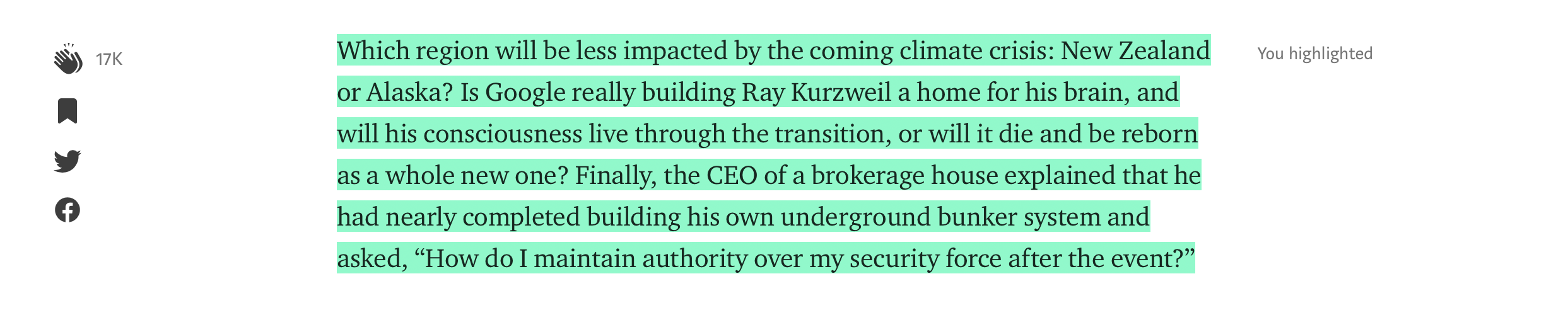
Fucked up, right? I’m reading Dark Money by Jane Mayer, given the current climate, I think it’s safe to say it’s going to be one of the most important books of all time! Everyone should get a copy! Now, for me, the whole purpose of doing things in early childhood is to make the world fairer, better, for all the people, all of Earth, not just the super rich for themselves.
So when I’m thinking about the product, besides thinking about how to make it fun and engaging so people will actually use it, I also am thinking about how we can nurture a progressive mindset, even if the parents have already been brainwashed by the ultra conservative idea machines. (Let this be the only time I’m spilling this hidden agenda. 😈) Hopefully, our kids will grow up to live in a better democracy, not a plutocracy or oligarchy.
There we go, another week of ideology rather than the business of Product Management. 😅 Sorry!
Actually, I have something to write about this week. So my top focus has been on our new research app that will be used for a study at Hong Kong University in July. Why this is my top focus is because if this study goes well, then another two universities overseas will use our app to conduct the same experiment. On top of that, a couple of top decision makers in the field of speech pathology is monitoring our progress. If things go well in these studies, they will give their approval and basically our app will become the standard and be recommended for clinician to use all over the country. Achieving that has to be top priority as it’ll give us the authority that no one else has, and also we are almost guaranteed to have real users to help us perfect our commercial app.
With that goal in mind, I set off creating a detailed spec for a high quality “Professional” app. I had many back and forth’s with the professional at HKU, clarifying every tiny little thing as we went through the workflow: somethings were removed, somethings were added, somethings were improved. By June 20th, the spec was already pretty tight and I’ve basically locked it down. And then, the next week, I got the news that we need to put the “Activities” back in it. The “Activities”, if you look at the current OTO app, is just a panel that takes you to a list of activities to do. So picture, words words words. I heard most people just tap it once, scroll to the bottom, and exit back out and never use it again. At this point, I’ve also been thinking about how to revamp the content consumption experience for a 3rd party partner, so I have some idea of how to make it much more engaging than a list of picture and words. But in any case, I looked at this situation, looked at our timeline, and I made a decision that I thought was the right call — No. Cannot change the development plan now. As a PM, it’s my job to protect the development team from sidetracking, and I also like to make sure we produce high quality products. I thought we could do the HKU study without activities, and in the next 2 months, we’ll make an awesome version of activities, and that’ll give us the added benefit of seeing the difference in engagement. Well, this week in the company meeting, I found out that I’ve basically misunderstood the goal. “The goal of the research isn’t to prove which feature improve language development, that’s a never-ending quest, we’ll let the researchers do that. Our goal is just to prove our whole set of features — a hardware recording device, feedback to parents on word count, and activity samples, will improve language development when compared to the control group.” So, the activities don’t even need to be engaging. We don’t care if the users use it or not. As long as it’s there, we’re good.
Anyway, I think the moral of the story is, make sure you know what’s the goal of each project, and if requirements change in the middle of development, reconfirm the goal again. I think.
Alright, this time I really wanna know what you think! Com’on, do you know any experienced product people? Forward this to them and ask them to give me some advice!
Next time I think I want to touch on work culture. I just took my kids wading in the river near our house, didn’t take my phone, went with the kids’ pace. Two hours went by in a flash. There is a lot to be learned from living slow, but will it translate well into a company’s culture? Again, if we’re creating a product to help children live a good life, should we first learn to live a good life ourselves? What is a good life?